
Organic Farming in the San Joaquin Valley: Optimizing Soil Health and Managing Pests
- Marisa Johnson

- 2 days ago
- 3 min read
On March 13th, F3 Local co-hosted a field day for organic and organic-transitioning growers with Community Alliance with Family Farmers (CAFF) and UCANR's Climate Smart Agriculture program. This event brought together many local farmers and service providers for a full morning of soil education, organic pest management strategies, and resource sharing. Farmers shared their own insights and experiences on the topics alongside our facilitators, making for an enriching learning experience for all.
Interpreting Soil Tests and Soil Health Best Practices
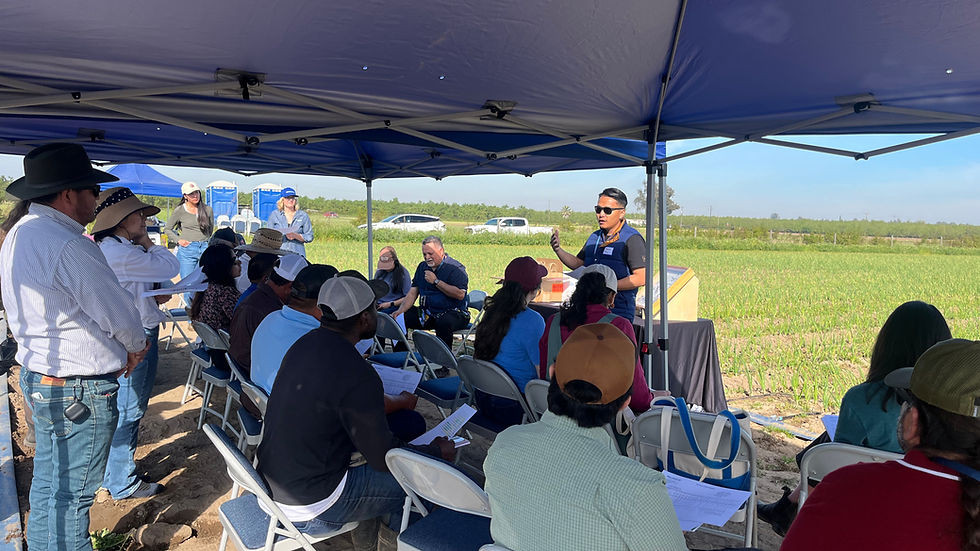
Dr. Tou Yee Thao, F3 Local Project Scientist and soil health expert, led our soil health discussion. Based on samples collected from the fields of eight farmers, most of whom were in attendance, he discussed how to read Nitrogen, Phosphorus, Potassium, and Calcium levels, and strategies for addressing inadequate levels of these nutrients. For example, Calcium was observed to be very low in all the tested soils. This can be an issue for those planting tomatoes in the field. Low levels of Calcium can lead to blossom end rot, damaging tomato crops and inhibiting market sales.
Soil tests can provide important information regarding your soil nutrient profile and empower farmers to make informed decisions. Low levels of Nitrogen, Phosphorus, or Potassium might indicate that your soil could benefit from regenerative practices such as applying compost and planting a cover crop mix.
Another critical indicator of soil health is soil organic matter. Typical California soils are made up of only 1 to 3 percent organic matter in cultivated agricultural fields. While that might sound low, even small changes make a massive impact. Soil organic matter builds up slowly over time. This matters because the more soil organic matter, the better your soil can hold water and nutrients, bolstering overall plant health.
How to Interpret a Soil Test from the NCAT and UA Extension
NCAT- Espanol, UA Extension - Espanol, UA Extension–English
Organic Pest Management Strategies
Led by CAFF’s Ecological Farming team, our next discussion involved various approaches to organic pest management. Emma Centeno, Erica Garibay, and Jade Gutierrez-
first introduced the various types of integrated pest management with examples. These included:
Cultural Control–the specific practices that reduce pest reproduction, dispersal, and survival, such as crop rotation and soil preparation
Physical Control–direct interventions that block or kill pests, such as traps or barriers like screens or floating tunnels
Biological Control–the integration of natural predators and beneficial insects that target harmful pests
Chemical Control–the use of pesticides

There was particular interest in biological control of pests on organic operations, and aphids are a consistent concern for growers. To address this, CAFF staff brought along live, green lacewings to place in the field at our host farm, Bon Pack Farms. Green lacewings are considered beneficial insects as their larvae feed on mites and soft-bodied insects such as aphids, mealybugs, scales, and thrips.
To further support their proliferation, it is recommended to plant a perennial habitat for lacewings and other beneficials. These perennial habitats are known as hedgerows. Hedgerows often include native shrubs and plants that flower year-round, providing a food source for adult insects.

For the San Joaquin Valley, plant Toyon, California lilac, Black sage, California goldenrod, California fuchsia, and California buckwheat for year-round blooms and native habitat.
To conclude the ecological pest management session, farmers were led on a pest scouting exercise. This included in-field observation of pests on crops and of sticky traps placed throughout the farm. The sticky traps mostly captured beneficial insects, like bees, indicating what already exists.
Local Resources for Organic Growers
This event provided a focused learning space for organic, small, diversified farmers in Madera and Fresno counties to ask questions, share their knowledge, and connect to resources. CAFF’s team provided information, including their free water testing service, the Organic Marketing Toolkit, and the ecological farming database. Further business support is also available to farmers through Kitchen Table Advisors’ work in Madera and Fresno counties and Feed the Hunger Fund.
Sources:

Comments